Blog
/
Behind the Kitchen
What Food Safety Looks Like When You Serve 10,000 Meals Every Day
At 10,000 meals a day, food safety stops being a checklist and becomes a manufacturing discipline. That's the part most people underestimate.

Posted at
Posted on
Behind the Kitchen
At 10,000 meals a day, food safety stops being a checklist and becomes a manufacturing discipline.
That's the part most people underestimate. A restaurant kitchen serving 200 covers can catch problems by eye - a chef tastes, a manager walks the line, something looks off and gets pulled. At scale, that model breaks down completely. By the time a problem becomes visible, it has already been portioned into 3,000 containers and dispatched to fourteen offices across three cities.
So the entire approach inverts. You stop relying on detection and start engineering for prevention. Every batch is documented, every temperature is logged, every supplier is checked, and every step has a control point that must be cleared before the next one begins.
Here's what that actually looks like on an ordinary Tuesday, from 4 a.m. to the last container returning to the wash bay.
Food-Safety Controls for the Ingredients We Handle
Before anything else, the structural decision that shapes everything downstream: we run a 100% vegetarian kitchen.
A kitchen’s menu does not by itself establish its food-safety performance. Dairy, cooked grains, fresh produce, hands, surfaces and equipment can all introduce or spread hazards. Evaluate the controls that apply to the actual ingredients and workflow.
Vegetarian production still needs separation of unwashed produce from ready-to-eat foods, safe handling of dairy and cooked foods, allergen controls and documented cleaning. The absence of meat does not eliminate cross-contamination or the need for handling protocols. Confirm the facility’s actual dietary segregation arrangements before relying on them.
Fewer variables means tighter control. That's the foundation everything else sits on.
It Starts Before the Kitchen: Supplier Control
The single highest-leverage food safety decision is made at procurement, not at cooking.
At our volumes, every vendor is approved, documented and periodically reviewed - storage and transport conditions inspected, and traceability maintained so that any ingredient in any batch can be traced back to a specific supplier and a specific delivery date. That traceability is the difference between a contained issue and an untraceable one.
Incoming material is not simply unloaded. It is inspected at the dock:
Temperature checked on arrival for dairy, paneer, curd and all chilled items, with rejection thresholds that are non-negotiable regardless of how tight the production schedule is
Visual and organoleptic inspection of vegetables, fruits, dairy and staples against defined acceptance standards
Batch and expiry documentation recorded before material enters storage
Separate receiving flow for unwashed produce, so soil-carrying vegetables never share a path with washed or ready-to-eat items
Material that fails is rejected. This sounds obvious. It becomes difficult only when 10,000 people are expecting lunch in six hours, which is precisely why the decision authority sits with the quality function, not with production.
Storage: Where Most Contamination Actually Originates
Cross-contamination in a vegetarian kitchen rarely happens dramatically. It happens when a crate of unwashed, soil-covered vegetables sits above a tray of cut salad, or when curd is stored a few degrees warmer than it should be over a long weekend.
Controlled storage means separate zones for dairy, fresh produce and dry goods, each held at its own defined temperature band, with monitoring and logged readings rather than a thermometer someone checks when they remember. Chilled storage is monitored continuously. FIFO rotation is enforced by labelling and layout, not by memory.
Dry storage - grains, pulses, flour, spices, oil - is pest-controlled, off-floor and inspected on a fixed schedule, because at bulk quantities these are the items most vulnerable to infestation and moisture damage. Chemicals and cleaning agents are stored in an entirely separate area, a boring detail that prevents one of the more serious incident categories in institutional food service.
Preparation: Zoning, Water and Hands
The prep floor is divided into zones with defined flow. Material moves in one direction - from receiving through washing, cutting, cooking, portioning and dispatch - and does not travel backwards.
Vegetables are washed in potable, quality-checked water, with sanitising washes for items served raw or minimally cooked, such as salads and cut fruit. Colour-coded boards and utensils separate unwashed produce from washed and ready-to-eat preparation, and keep allergen-relevant items - dairy, nuts, and where applicable, gluten-containing preparations - on dedicated equipment.
Staff hygiene is where scale helps rather than hurts, because it can be systematised. Every person on the floor works under enforced protocol: hairnets, gloves, aprons, closed footwear, no jewellery, structured handwashing at defined intervals and after defined activities. Health status is monitored, and anyone reporting illness symptoms is removed from food handling — a rule that only works if the staffing depth exists to cover them, which at our scale it does.
Cooking: Temperature Is the Control Point
This is the step that eliminates pathogens, and it is treated as a measured control rather than an assumption.
Core temperature is verified with calibrated probes at the end of the cook - not estimated from cooking time, and not judged by appearance. This matters most for the items people assume are low-risk: dairy-based gravies, paneer preparations, cooked rice held before service, and pulses cooked in large volumes. Every batch has a recorded reading against the standard for that preparation.
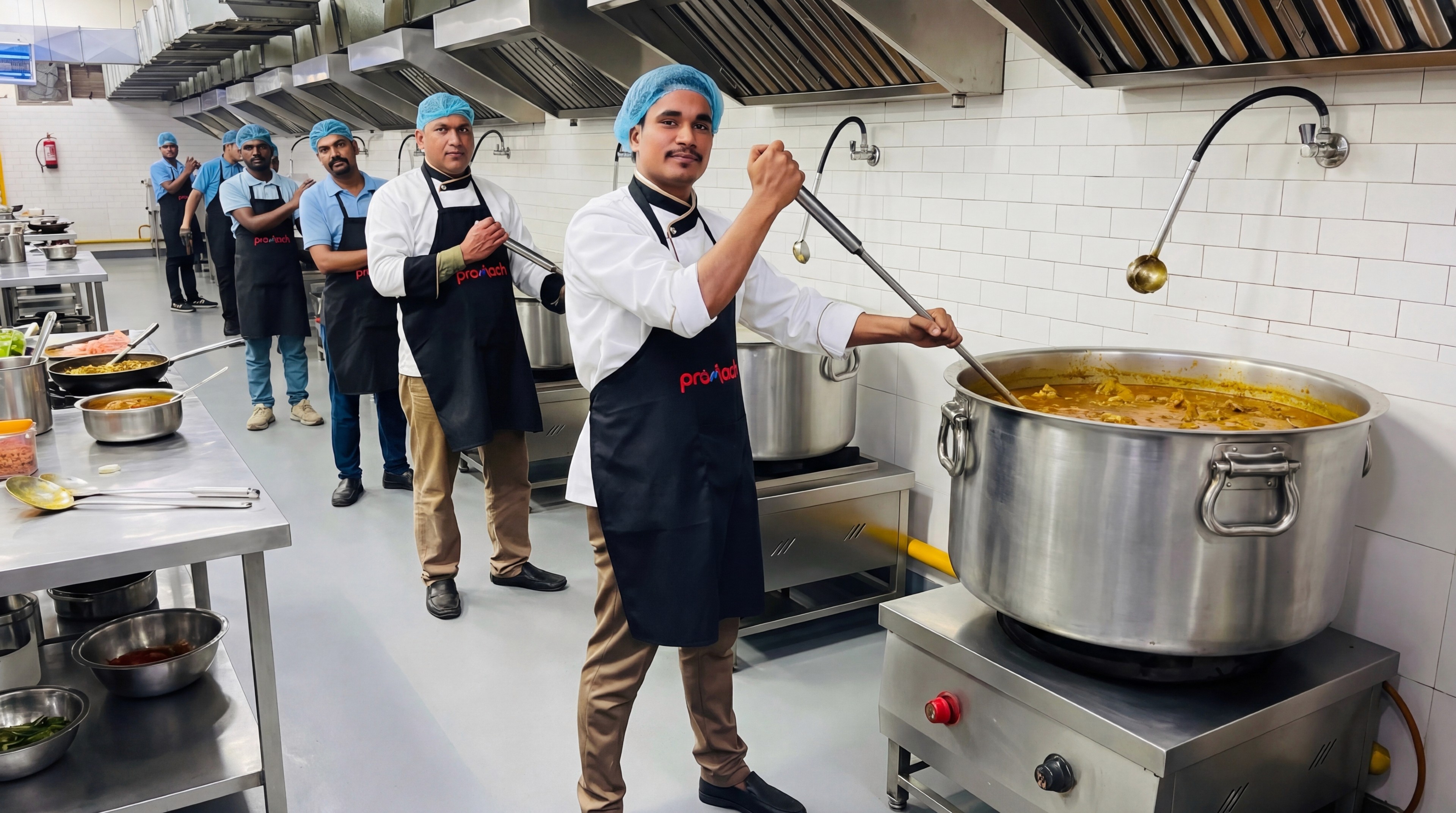
Bulk cooking equipment is used precisely because it delivers uniform heat through large volumes, eliminating the cold spots that cooking large quantities over open flame inevitably creates. Batch records tie each preparation to its cook time, temperature, operator and equipment. If a question arises three days later, the answer exists in writing.
The Danger Zone Is the Real Enemy
Between roughly 5°C and 60°C, bacteria multiply rapidly. At 10,000 meals daily, the time food spends in that band is the most important number in the entire operation - more important than any single cooking step.
Cooked rice, dairy gravies and cooked pulses are the highest-risk items in a vegetarian kitchen, and all three are managed on both sides of the temperature range:
Hot holding at or above 65°C, continuously monitored, from the end of cooking through to service
Rapid cooling where required, using a validated process appropriate to the food and batch size, with the time-temperature limits checked and recorded
Defined shelf life from production to consumption, with dispatch timing built around it rather than around convenience
Insulated, temperature-maintained transport to all 50+ delivery locations, with arrival temperatures logged at the receiving end
That last point matters more than most buyers realise. Transport safety depends on the food, its time-temperature history and the effectiveness of the holding system. Hot food can require controlled hot holding, while chilled food requires cold control; vehicle refrigeration alone does not determine whether a meal is safe. Distribution is part of the food safety system, not a logistics afterthought.
Retention and Traceability
Every day's production is sampled and retained under refrigeration for a defined period. If any concern is raised - by a client, by an employee, or internally - there is a physical sample of exactly what was served, not a recollection of it.
Water quality is checked periodically. Surface and equipment swabs verify that cleaning protocols are actually working rather than merely being performed.
Combined with supplier traceability and batch records, this means any item on any plate can be traced backwards through cooking, prep, storage and receiving to its source. That chain is what turns a potential incident into a contained, explainable, quickly resolved event.
Cleaning and Waste: The Unglamorous Half
Sanitation runs on a documented schedule with defined chemicals, contact times and verification - daily, weekly and deep-clean cycles, each signed off. Dishwashing operates at validated temperatures rather than at whatever the machine happens to be running.
Waste is segregated and removed on a fixed frequency, never accumulating near production areas - particularly vegetable trim and peel, which at bulk volumes attracts pests fast if left standing. Pest management is scheduled, recorded and monitored across mapped points throughout the facility.
None of this appears in a photograph of a good-looking thali. All of it determines whether that thali is safe.
People: The System Only Works If They Do
Protocols don't execute themselves. Every food handler is trained on hygiene, temperature control, allergen awareness and contamination prevention, with refresher training on a fixed cycle rather than at induction only. Supervisors verify compliance on shift, and internal audits check the supervisors.
The cultural piece is harder and more important: a floor where stopping a batch is rewarded rather than penalised. A system where reporting a problem carries a cost will reliably produce a kitchen where problems don't get reported.
Why Scale Makes This Better, Not Riskier
The intuition runs the other way - bigger kitchen, bigger risk. In practice, volume is what makes genuine food safety affordable.
A dedicated quality team, calibrated instrumentation, blast chilling capacity, temperature-controlled fleet, full-time training and documented audit trails are all fixed costs. Spread across a 200-cover canteen, they are unjustifiable. Spread across 10,000 meals a day, they cost very little per plate - and they buy a standard of control that a small kitchen cannot replicate at any price.
That is the honest argument for outsourcing bulk catering to a scaled operator. Not that it's cheaper. That it's documented, traceable and reviewable - by you, not just by us.
What This Means for the Companies We Serve
For an HR head or admin lead, food safety is a liability question before it is a hospitality question. A foodborne illness incident in an employee canteen is an operational disruption, a reputational problem, and in a plant environment, a serious safety event.
Serving 10,000+ vegetarian meals a day across 50+ offices means that risk is engineered out systematically and documented at every step - and that the documentation is available to you on request.
If your current arrangement can't produce a temperature log, a supplier record or a retained sample when asked, that's worth knowing before you need it.
Want to see how it works?
Promach serves 10,000+ pure vegetarian meals daily to 50+ corporate offices, with controlled procurement, monitored cold chain, temperature-verified production and full batch traceability from source to plate.
Request a food safety walkthrough or schedule a visit to our central kitchen - the standard is easier to trust when you've seen it.