Blog
/
Behind the Kitchen
How Does a Corporate Catering Company Serve 10,000 Meals a Day?
It's a fair question, and people usually ask it in one of two ways. Some ask it admiringly - how do you manage that?

Posted at
Posted on
Behind the Kitchen
It's a fair question, and people usually ask it in one of two ways.
Some ask it admiringly - how do you manage that? Others ask it sceptically, and that version is the more useful one: at that volume, surely something has to give. Surely food cooked for ten thousand people can't be food you'd actually want to eat.
The honest answer is that cooking for 10,000 people is not cooking for one person multiplied by ten thousand. It is a different discipline, with different constraints and different failure modes. Done badly, the sceptics are right. Done properly, scale is what makes consistency possible rather than what destroys it.
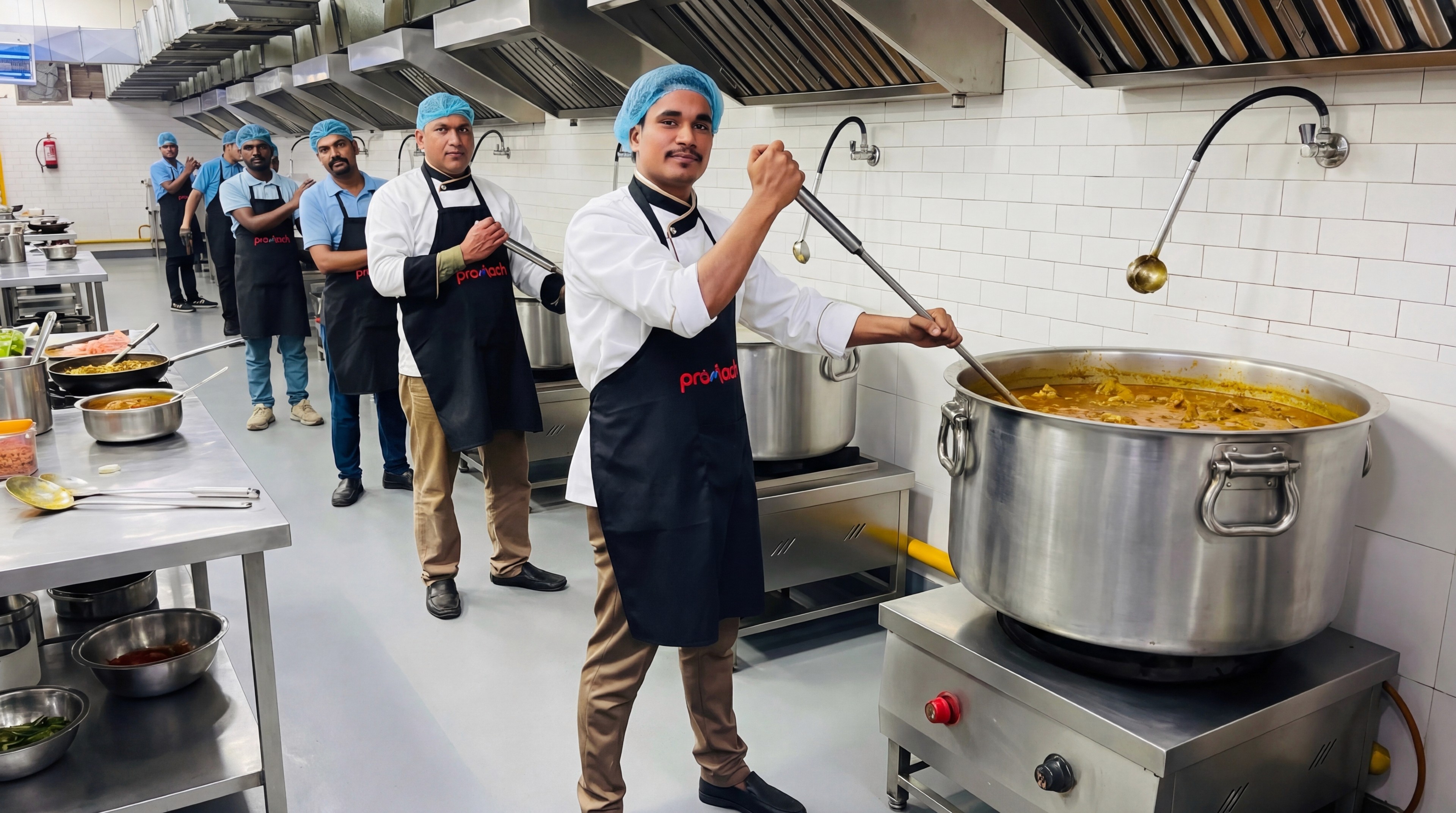
Here is how it actually works, hour by hour, in our kitchen.
First, what 10,000 meals looks like
In round terms, a single day's vegetarian production at this volume means something like:
Several hundred kilograms of dry pulses, before they become dal
Well over a tonne of fresh vegetables, arriving that morning
Tens of thousands of rotis, made in timed batches rather than one lot
Rice measured in hundreds of kilograms
Hundreds of litres of curd and dairy
None of that can be improvised. At 30 meals a day you can adjust as you go. At 10,000, every one of those quantities has to be ordered the previous evening, checked at the gate at dawn, cooked to a fixed process, and out of the door on a schedule - because there is no recovery time. If the dal is late, it is late for eleven client sites simultaneously.
That constraint is the whole story. Everything below exists to remove improvisation from the process.
The day, hour by hour
4:00 PM, the day before: headcount lock
Tomorrow's meal count closes today. Client sites confirm numbers, and those numbers drive everything downstream.
This is the least glamorous step and the most important one. Forecast accuracy is the single largest determinant of both food waste and food cost in bulk catering. A kitchen that knows on Monday evening how many people are eating on Tuesday can cook precisely. A kitchen that guesses either runs short or over-produces, and both are expensive - one visibly, one invisibly.
6:00 PM: indent and procurement
The confirmed count converts into an ingredient indent, and orders go to suppliers overnight. Vegetables are bought for next-morning delivery rather than held in storage, which is why menus track the season - it isn't a marketing preference, it's how you get produce that was in a field this week.
4:00 AM: goods inward and quality check at the gate
Deliveries arrive and are checked before they enter the kitchen. This is a rejection point, not a formality: temperature on dairy, visual and weight checks on produce, documentation on packaged goods, and batch details recorded so any ingredient can be traced back to its supplier later.
Anything that fails is turned away at the gate. It is far cheaper to reject a crate at 4 am than to discover a problem at 1 pm across eleven sites.
5:00 AM: preparation
Washing, peeling, cutting, soaking, tempering. This is the most labour-intensive stage and the one where hygiene discipline matters most, because it's the last point at which food is handled extensively before cooking.
Preparation areas need a clear separation between unwashed ingredients and ready-to-eat food, together with suitable cleaning and allergen controls. For vegetarian, Jain or other dietary requirements, confirm the actual ingredients, equipment and handling arrangements with the caterer. Segregation reduces specified risks; it is not a guarantee that contamination cannot occur.
6:30 AM: production
This is where bulk cooking either works or doesn't.
Cooking 400 kg of a dish over open flame means the first batch and the last batch are different foods. Temperature varies, timing varies, and the person stirring changes. Consistency becomes a matter of individual skill on a given morning.
Our production line runs on Rational iCombi Pro combi ovens - the same German combi-oven technology used in Michelin-starred kitchens. The relevant word is process-controlled. A programme runs to a defined temperature curve, humidity level and time, and it runs identically at 6:30 am and 8:15 am. Batch fifty is the same food as batch one.
Two consequences worth understanding:
Consistency becomes engineering rather than luck. The dal your team eats in March tastes like the dal they ate in November. In a daily programme, that repeatability matters far more than any single spectacular meal.
Nutrients survive better. Controlled steam and temperature preserve more than prolonged open-flame boiling does. At 240 meals per employee per year, that difference compounds.
Breads are made in timed batches against the dispatch schedule rather than in one early lot - because a roti made at 6 am and eaten at 1:30 pm is a texture every employee recognises and nobody enjoys.
8:30 AM: quality control and sample retention
Before anything leaves, each batch is checked - taste, texture, temperature, seasoning against the standard recipe.
Samples from every batch are retained and refrigerated. If a question about any meal arises days later, the physical evidence exists. That single practice separates kitchens that can answer questions from kitchens that can only apologise.
9:00 AM: packing and route loading
Food moves into insulated, temperature-holding containers, sealed and labelled by site. Vehicles are loaded by route rather than by dish, so that the last site on a route is not the last thing to be considered.
9:30 AM onward: dispatch across NCR
This is the part that is genuinely difficult, and no amount of kitchen quality survives getting it wrong.
Our kitchen sits in Sector 63, Noida - a deliberate choice, roughly equidistant from central Delhi and Gurgaon. From there, routes run to Delhi, across Noida and Greater Noida, out to Gurgaon, and into Faridabad and Ghaziabad.
Routes are planned around NCR traffic patterns, not around map distance. The Gurgaon route in particular is engineered backwards from the delivery window rather than forwards from the kitchen. Temperature integrity is maintained through the journey, because a client in Cyber City is entitled to the same food as a client next door to our facility - and they will not accept "the traffic was bad" as a reason twice.
12:00 to 2:00 PM: service
At client sites, food is held at temperature and served. Our staff at cafeteria and onsite locations handle counter service, replenishment and hygiene through the service window.
3:00 PM: the feedback loop
Waste is observed, feedback is collected, and consumption against forecast is recorded. This is where tomorrow's menu gets better. A dish that consistently comes back uneaten is a menu problem, and it's a problem you only find if someone is looking.
And then it starts again
By late afternoon, tomorrow's headcount is locking. The cycle has no gap.
Five things bulk catering has to solve that home cooking doesn't
1. Consistency is harder than quality. Anyone can cook one excellent meal. Producing the same excellent meal 250 working days in a row, across multiple sites, through staff changes and seasonal ingredient variation, is the actual problem. It is solved with standardised recipes, process-controlled equipment and documented specifications - not with talent alone.
2. Holding time has to be designed for. There are four to five hours between cooking and eating. A recipe that is perfect at the moment it leaves the pan and poor ninety minutes later is a failed recipe in this business, however good it tastes in a tasting. Dishes have to be built to survive the gap.
3. Cold chain and temperature discipline. Food safety in bulk is overwhelmingly a temperature story. Most things that go wrong in institutional catering go wrong because food spent time in a temperature range it shouldn't have.
4. Traceability. Every batch traceable to its ingredients, every ingredient traceable to its supplier, with records that survive an audit. This is what allows a problem to be isolated in hours instead of guessed at.
5. Redundancy. A vehicle will break down. A supplier will fail to deliver. A client will call at 9 am with sixty extra guests. Scale is what lets you absorb these without the client noticing - a second vehicle exists, a second supplier is approved, and the kitchen has the capacity to add sixty covers. A small operation has no slack. This is the one genuine advantage of volume, and it's the reason to care about it.
The food safety architecture, and why each part exists
Certifications are easy to list and harder to explain. Here is what ours actually do.
FSSAI licence is the legal baseline - the licence to operate at all.
HACCP is a system rather than a badge. It identifies the specific points in a process where contamination could occur and puts a control and a check at each one. It's the difference between "we're careful" and "here are the seven points where this could go wrong and here is what we monitor at each."
ISO 22000 wraps that into a management system, with documentation, internal audits and corrective-action procedures. It's what makes the discipline survive a change of personnel.
FoSTaC training puts certified food-safety knowledge at every level of the team, not only in management. FSSAI requires a trained Food Safety Supervisor for every 25 food handlers. Handling discipline on the floor is where safety is actually won or lost.
Ongoing audits, not one-time paperwork. A certificate issued four years ago proves something about four years ago. Certification maintained through regular audit proves something about now. Ours are current and available for client review - and we'd encourage you to ask any caterer for theirs with dates attached.
The people
Roughly seventy trained staff members, and the structure matters as much as the number: chefs and production teams on the line, quality control separate from production so that checking isn't done by the person being checked, route supervisors accountable for delivery windows, site staff at client locations, and a named account manager per client so that when something goes wrong on a Tuesday you speak to a person rather than a helpline.
Menu engineering, not menu writing
At 10,000 meals a day, the menu is a system.
A four-week minimum rotation, because repetition is what kills participation in a lunch programme faster than anything else.
Dietary variants built into the plan rather than handled as exceptions - Jain, vegan, low-oil, diabetic-friendly and high-protein options designed alongside the main menu.
Seasonal produce, which is simultaneously the better-tasting choice and the better-costed one.
The festival calendar planned in advance - Navratri, Shravan, Paryushan, Ekadashi. A caterer who is surprised by these every year isn't paying attention to the people eating the food.
Feedback that changes something. Consumption data and site feedback feed the next cycle. A menu that never changes in response to what people actually eat isn't being managed.
What goes wrong, and what we do about it
Any caterer who tells you nothing ever goes wrong is telling you they haven't operated at scale.
Traffic and weather. Routes are built with buffer, and dispatch sequencing is adjusted on bad days. When a delay is unavoidable, the client hears it from us before they hear it from their employees.
Supplier failure. Approved alternates exist for every significant ingredient. This is boring, and it's the reason a bad morning at one vendor doesn't become a bad lunch at eleven sites.
Sudden headcount changes. Capacity absorbs it. This is what the 20,000 sq ft facility is for.
Complaints. Retained samples, batch records and a named account manager mean a complaint can be investigated properly rather than met with a general apology. Most complaints have a specific, findable cause.
The number that actually matters
Ten thousand meals a day is a capacity figure. It tells you what a kitchen can do. It doesn't tell you whether anyone wants to keep eating the food.
The number we'd point to instead is 80% client retention, with several partnerships now past their tenth year. In corporate catering, contracts come up for review annually and switching costs are low. Clients who stay are making an active choice, repeatedly, with full knowledge of what the alternatives quote.
Scale is straightforward to claim. Renewal is difficult to fake.
Final thoughts
The answer to "how do you serve 10,000 meals a day" is not a secret and it isn't glamorous. It's a locked headcount the evening before, a rejection point at the gate at 4 am, a process-controlled cooking line that removes the variable of who's on shift, retained samples, temperature-held transport routed around NCR traffic, and a feedback loop that actually changes the menu.
It is, in short, the removal of improvisation from every step where improvisation could hurt someone - so that the only thing left to vary is whether the food is good. And that part still comes down to cooking it like it matters.
Come and see it.
The most useful thing you can do when evaluating any caterer is to walk through their kitchen. Promach Hospitality has been feeding corporate Delhi NCR for thirteen years, from a 20,000 sq ft HACCP-certified, ISO 22000-compliant, FSSAI-licensed central kitchen in Noida Sector 63, serving 50+ organisations across Delhi, Noida, Gurgaon, Greater Noida, Faridabad and Ghaziabad.
We'd rather show you the facility than describe it. Turn up unannounced if you'd prefer - it tells you more.
Tell us your location, headcount and timing, and we'll come back with a tailored proposal within 24 hours. Our minimum for daily corporate programmes is 30 meals a day, and we cater events from 50 guests upward.
Get a quote · Book a 15-minute call · +91-9953460631